
In the First Person Dream Catcher rules cited here, landing on 2x or 7x keeps all existing bets in place and closes betting for the follow-up spin. The multiplier does not finish the round or open a fresh opportunity to change your numbers. Consecutive multiplier results multiply together: 2x followed by 7x makes a factor of 14, applied when a numbered result finally settles the bets.
That distinction matters when a history shows several wheel stops but the balance contains one accepted set of bets. Counting every multiplier stop as another purchase would overstate the cost. Counting each stop as an immediate prize would overstate the credit.
This Dubai7 guide follows the First Person Dream Catcher chapter in Evolution’s published v2.7.4 rulebook. First Person is the animated RNG version, as Evolution’s product page explains. We keep its SPIN-button and five-second continuation rule within that version; this is not a promise about a particular casino’s current interface or a live presenter’s controls.
A numbered 2 is different from the 2x sector
The cited wheel has 54 equal sectors. Fifty-two carry one of six numbers—1, 2, 5, 10, 20 or 40—and the remaining two carry 2x and 7x. Bets are placed on the numbers. A number resolves whether a selected bet wins; a multiplier extends the existing sequence.
| Wheel result | What it does to the current bets | What to check next |
|---|---|---|
| Number 2 | Settles bets using number 2's ordinary 2:1 profit odds, adjusted by any carried multiplier | Was there an accepted bet on number 2? |
| Multiplier 2x | Keeps all bets in place and applies a factor of two to the eventual winning odds | Continue to another wheel result |
| Multiplier 7x | Keeps all bets in place and applies a factor of seven to the eventual winning odds | Continue to another wheel result |
| Another unselected number | Ends the sequence without a winning selected-number bet | Do not turn a previous multiplier into a separate prize |
For example, a bet on number 2 does not win merely because the pointer stops on 2x. Those are separate sectors with separate functions. The 2x result can eventually help a winning bet on 5, 10 or any other accepted number; it is not reserved for a bet on number 2.
Also distinguish the number of sectors from the number of selectable numbers. There are six number choices, but their sector counts differ. This article does not treat those six numbers as equally likely or turn the diagram below into an RTP calculation.
What stays open after a multiplier?
Under the cited rules, all accepted bets remain where they were when the wheel hits 2x or 7x. No new bets are allowed during that continuation. You cannot wait to see 7x, add a fresh bet to 40 and treat it as if it had been present at the start.
The same rule prevents moving an original bet from one number to another during the multiplier sequence. The unresolved result belongs to the accepted selection. A new betting round after settlement is a different event, with its own accepted wagers and costs.
The text tells the First Person player to use SPIN to continue after a multiplier. If SPIN is not clicked or tapped within five seconds, the wheel spins automatically until it reaches a numbered sector. It also describes automatic continuation when multipliers repeat. That is a continuation of the unresolved bets, not evidence that the account has bought a new set of bets each time.
Do not confuse that documented continuation with choosing an ongoing autoplay mode. The five-second passage addresses what happens to a pending multiplier outcome. It does not establish every setting, permission or control in a currently offered client.
Work out the multiplier chain before the money
Start with the ordinary odds of the final numbered result, then multiply by every preceding 2x or 7x in that sequence. The rulebook’s example is 2x, then 7x, then number 5: 5:1 becomes 70:1 because 5 × 2 × 7 = 70.
| Complete sequence | Winning odds for a bet on the final number | Meaning |
|---|---|---|
| Number 5 | 5:1 | No multiplier carried into the result |
| 2x → number 5 | 10:1 | 5 × 2 |
| 7x → number 5 | 35:1 | 5 × 7 |
| 2x → 7x → number 5 | 70:1 | 5 × 2 × 7, not 5 × 9 |
| 2x → 2x → 7x → number 5 | 140:1 | Both separate 2x results count |
These are conditional arithmetic examples, assuming the applicable maximum does not bind. The cited chapter says consecutive multipliers are subject to a maximum win shown in the Bet Limits panel. It also states that the round’s total payout is limited. It does not give us one universal currency cap to insert into every account.
Two calculations that look similar answer different questions. The multiplier factor for 2x then 7x is 14. The resulting profit odds on number 5 are 70:1. Neither number is yet the whole balance credit, because the accepted stake on the winning number still matters.
One complete account: 10 on 5 and 4 on 2
Use an invented account with a starting balance of 1,000. The accepted bets are 10 on number 5 and 4 on number 2. Their combined cost is 14, leaving 986 after acceptance. Assume no fees, refunds, other bets or transactions, and that the applicable maximum does not restrict any example below.
Suppose the wheel then stops on 2x, 7x and finally number 5. All original bets stay in place through the two multiplier results. The final 5 wins for the 10 staked on 5; the separate 4 on number 2 loses.
The winning profit is 10 × 5 × 2 × 7 = 700. The cited rules expressly return the stake on the winning sector alongside the winnings, so the credit is 700 + 10 = 710. The final balance becomes 986 + 710 = 1,696. Compared with the original 1,000, the net change is +696.
| Entry in this invented account | Balance movement | Running balance |
|---|---|---|
| Start | No transaction | 1,000 |
| Accept 10 on 5 and 4 on 2 | −14 total | 986 |
| Stop on 2x | Bets remain unresolved; no fresh bet in this account | 986 |
| Stop on 7x | Bets remain unresolved; no fresh bet in this account | 986 |
| Final number 5 | Credit 710: profit 700 plus winning stake 10 | 1,696 |
Calling the net gain 700 would overlook the separate losing 4. Calling the credit 724 would return both original bets even though only the stake on the winning sector is returned. Subtracting 14 three times would invent two extra sets of accepted wagers.
Those mistakes come from mixing three different amounts: profit on the winning selection, total closing credit and net change across all accepted selections. Keep all three visible before comparing the history with a balance entry.
What if the same multipliers end on another number?
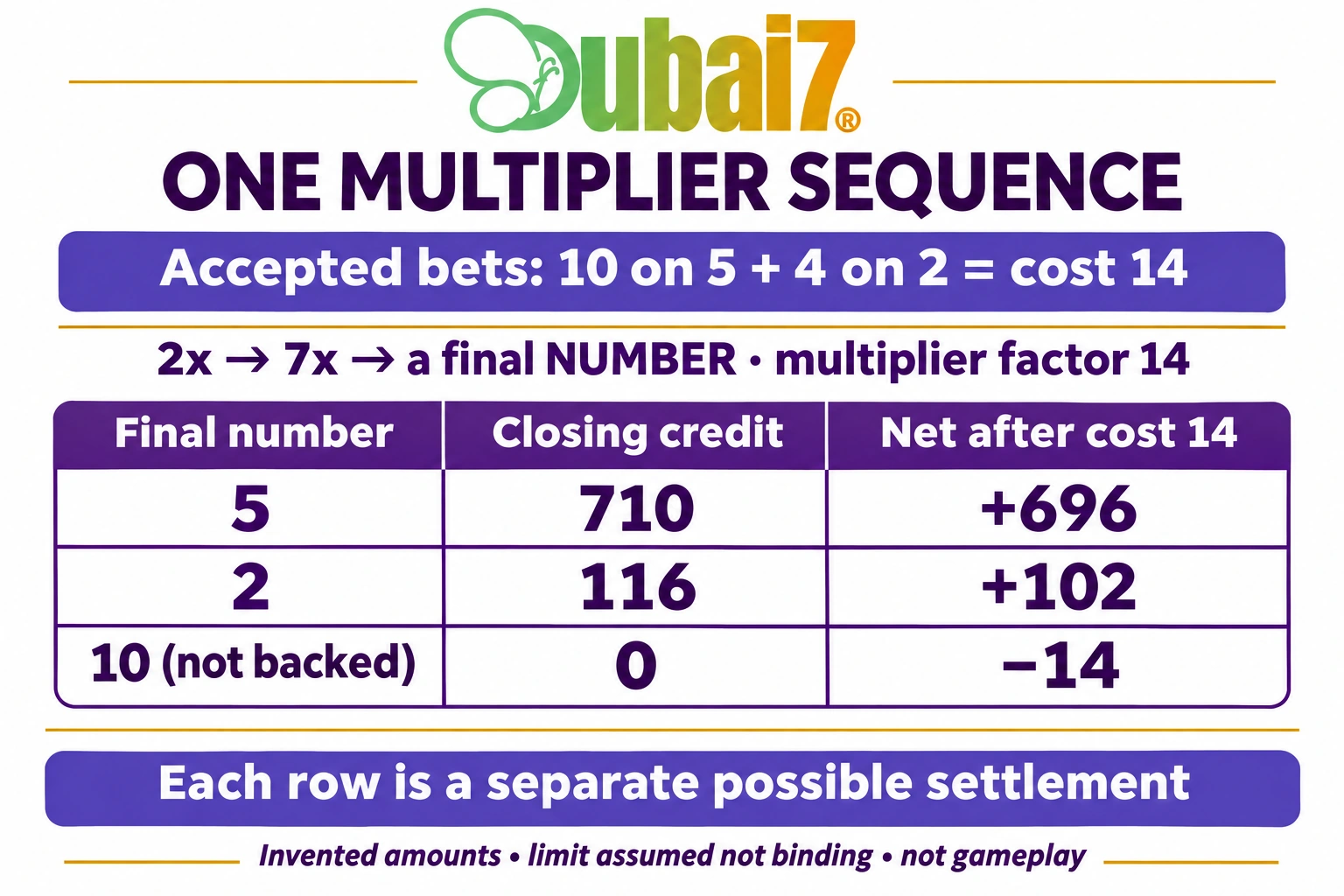
The 2x and 7x sequence does not guarantee that an accepted number will win. Keep the same initial bets and factor of 14, but compare three separate possible final numbered results.
| Final result after 2x → 7x | Closing credit | Net change after the full 14 cost |
|---|---|---|
| Number 5, with 10 staked there | 10 × 5 × 14 + 10 = 710 | +696 |
| Number 2, with 4 staked there | 4 × 2 × 14 + 4 = 116 | +102 |
| Number 10, with nothing staked there | 0 | −14 |
Each row is an alternative settlement, not a later event in the first row’s account. In the number-2 branch, the winning profit is 112 and the winning stake returned is 4. The losing 10 on number 5 remains part of the full cost. Starting from 1,000, that branch finishes at 1,102.
In the unbacked-number-10 branch, there is no winning selected-number bet to multiply. The earlier 2x and 7x do not become standalone payments. The account stays at 986, which is 14 below its starting balance.
This comparison explains the mechanism without suggesting that a long multiplier sequence makes the next selected number certain or that increasing a wager after seeing one is possible. The bet state has already been fixed for that sequence.
Which record tells you whether a respin was charged?
Match the game version, round identifier, accepted selections, stake debits, ordered wheel results and final credit. A history may show several wheel results for one unresolved sequence. Counting those pictures alone cannot establish how many separate accepted bets were charged.
For a suspected extra debit, identify the actual transaction and its acceptance event. It may belong to a separate round or another selection; this article cannot decide that from a multiplier icon. For a suspected short payment, establish the final numbered result, the stake accepted on that number, every multiplier in that sequence and the applicable limit before comparing the credit.
The question is specific: which accepted wager or settlement does this entry represent? Replacing that evidence with “three spins must mean three charges” or “7x must mean a separate prize” produces a misleading account.
Common questions
Can I place a new bet after the wheel lands on 7x?
Not during the multiplier continuation described in this version. Existing bets remain in place and no new bets are allowed. A later open betting round is a separate set of accepted bets, rather than a way to join the unresolved 7x sequence.
Does 2x followed by 7x make 9x?
No. Consecutive multiplier results stack by multiplication. Their factor is 14; if the sequence ends on number 5, its ordinary 5:1 profit odds become 70:1. The winning stake determines the money amount.
Does missing SPIN for five seconds cancel the bets?
The cited First Person passage describes automatic continuation to a numbered result after that five-second window. It does not describe cancellation or a refund merely because the player did not tap SPIN. Keep that rule separate from an unverified connection error or another game’s controls.
Is 710 the profit on a 10 bet at 70:1?
In the example, 700 is the winning profit and 710 is the closing credit including the returned winning stake. With the separate losing 4 included, the whole account’s net gain is 696. The three figures describe different parts of the same account.
The mechanism and timing above follow Evolution’s published First Person Dream Catcher rules, physical pages 196–197. Evolution’s product description identifies the First Person RNG version and its 2x/7x features. The balances and diagrams are Dubai7 teaching examples, not gameplay screenshots or confirmation that this information site offers the game.