
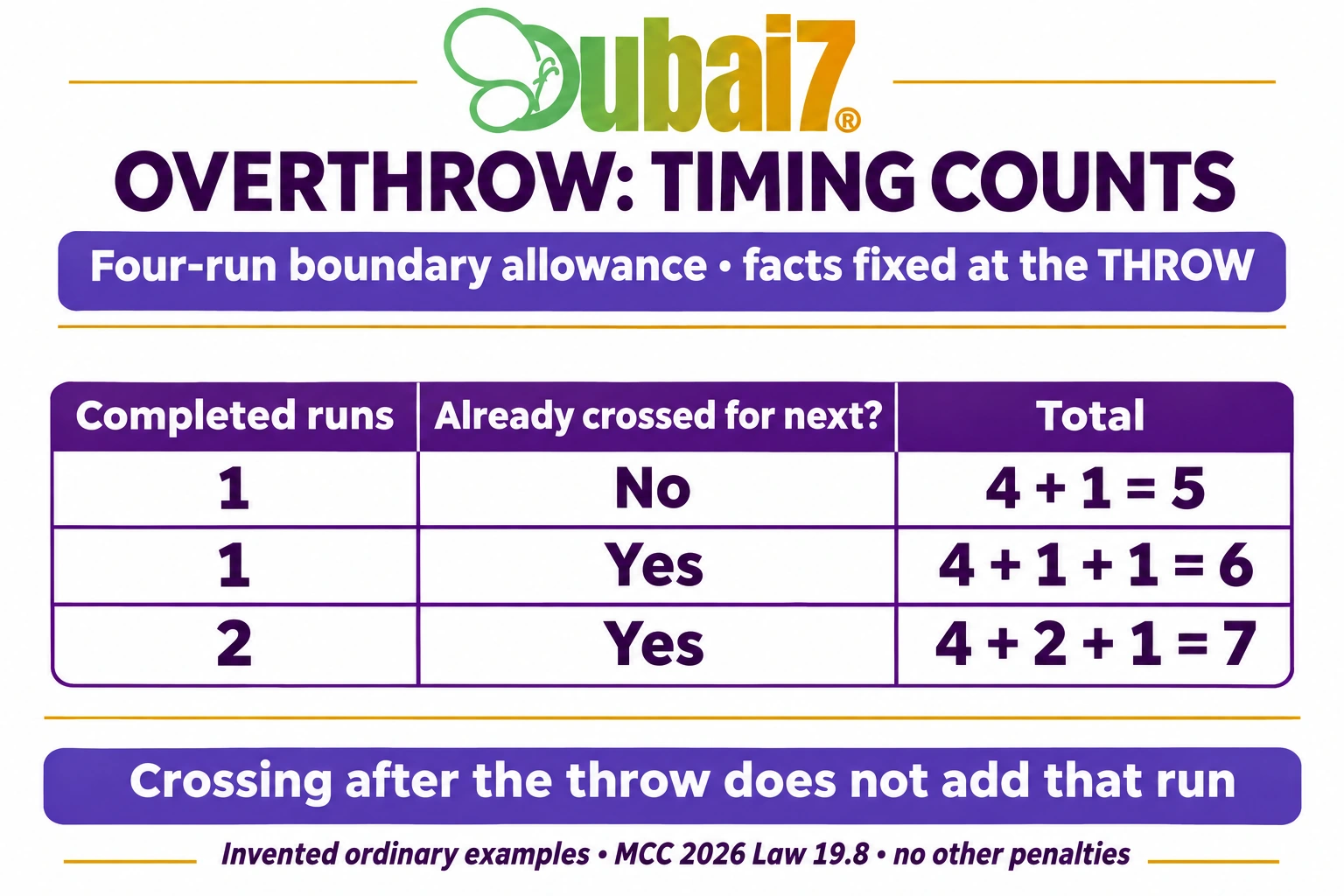
An overthrow boundary can add the boundary allowance to runs completed before the fielder’s throw, plus the run in progress if the batters had already crossed when that throw occurred. With the usual four-run allowance, two completed runs and a crossing already made for the third can therefore produce seven—not simply four, and not every run eventually finished before the ball reaches the rope.
The key moment is the throw, while the key first question is whether the boundary qualifies as an overthrow at all. Under the MCC 2026 Laws used here, an attempt to stop a ball that deflects over the rope is expressly treated differently from a throw directed towards the wickets to effect a Run out or prevent further run-scoring.
This Dubai7 explanation follows Law 19 of the 2017 Code, fourth edition 2026. It explains that named version rather than applying it retrospectively to a famous match or assuming every competition has adopted identical playing conditions. All examples are invented ordinary deliveries with no wicket, deliberate short running, interference or other special incident unless stated.
First decide what kind of boundary occurred
Law 19.8.2 defines the relevant actions. A boundary results from an overthrow when, in the umpire’s opinion, a fielder directs the ball towards the wickets in an attempt to Run out a batter or prevent further run-scoring, and the ball subsequently crosses the boundary.
The same definition expressly excludes a ball crossing the boundary as the result of a fielder attempting to stop it. It also excludes a short pass to another fielder while fielding near the boundary. A fielding mistake can be expensive without qualifying for the special additive overthrow calculation.
| Fielding event in the cited edition | Which calculation to examine? | Why the distinction matters |
|---|---|---|
| Throw towards the wickets to attempt a Run out; ball goes to the boundary | Overthrow calculation under 19.8 | Add the allowance to the qualifying runs fixed at the throw |
| Attempt to stop the ball; it escapes to the boundary | Ordinary boundary calculation under 19.7 | Do not automatically add the runs already run to four |
| Short pass near the boundary to another fielder; ball crosses the boundary | Expressly excluded from an overthrow by 19.8.2.2 | A pass is not enough by itself to establish an overthrow |
| Deliberate action not intended to prevent runs, effect a Run out or complete a catch | The particular definition of wilful act in 19.8.2.3 | Do not call every intentional throw a “wilful act” for this purpose |
Classification depends on the actual action and the umpire’s judgement. A commentary label such as “overthrow!” does not supply all the facts required by the named Law. Check the direction and purpose of the action before selecting the formula.
Our worked examples below use an accepted overthrow directed towards the wickets. They assume a Boundary 4 allowance of four, which is the default under 19.6 unless the allowance was determined differently before the toss.
The throw freezes which running counts
For an overthrow boundary, Law 19.8.1 combines applicable penalties, the boundary allowance, runs completed at the instant of the throw or wilful act, and the run in progress if the batters had already crossed at that instant.
Separate three events: a run completed, the next run’s crossing, and the throw. The batters may still be running while the ball travels towards the boundary. Their later movement does not replace the Law’s earlier reference time.
| Situation at the instant of the throw | Running counted alongside a four-run boundary | Total without other penalties |
|---|---|---|
| One run completed; not yet crossed for the second | 1 | 5 |
| One run completed; already crossed for the second | 1 + 1 | 6 |
| Two runs completed; not yet crossed for the third | 2 | 6 |
| Two runs completed; already crossed for the third | 2 + 1 | 7 |
In the first row, suppose the batters cross for their second run a moment after the throw and finish it before the ball reaches the rope. The total is still five in this uncomplicated example: four plus the one completed run at the throw. The crossing happened after the reference instant.
In the second row, the crossing for the second run had already occurred when the throw was made. That run in progress is included even though it was not yet complete at that instant. The total is six: four plus one completed plus one qualifying run in progress.
“Already crossed” is therefore not the same as “eventually completed.” Nor is a screenshot showing two batters on opposite sides of the pitch enough without knowing when the throw occurred. The timing comparison is the evidence that separates those two rows.
Compare an ordinary boundary with the same running
For an ordinary boundary, 19.7.3 generally awards the greater of the boundary allowance and the runs completed, including the run in progress if the batters had already crossed when the boundary is scored. It does not normally add those alternatives together.
That differs from 19.8 in both the arithmetic and the reference instant. Use an ordinary Boundary 4 with no penalties and no overthrow: if two qualifying running runs are involved, the total is four, not six. If five qualifying running runs exceed the four-run allowance, the total is five rather than nine.
| Example with the usual four-run allowance | Relevant running amount | Result |
|---|---|---|
| Ordinary boundary; two qualifying running runs at the boundary | 2 | Greater of 4 and 2 = 4 |
| Ordinary boundary; five qualifying running runs at the boundary | 5 | Greater of 4 and 5 = 5 |
| Overthrow boundary; two completed runs at the throw, no crossing for another | 2 | 4 + 2 = 6 |
| Overthrow boundary; two completed and crossed for the third at the throw | 3 | 4 + 2 + 1 = 7 |
This is why “they ran two, so add two to four” is incomplete. It can be right for the third row and wrong for the first. Determine the boundary category before using the amount of running.
The ordinary rule’s “greater of” comparison also prevents the opposite mistake: assuming the boundary can erase five qualifying runs and reduce them to four. The cited Law expressly preserves the higher qualifying running total in that situation.
A full score entry, including a No ball
Consider a separate invented delivery. The striker hits the ball with the bat, the delivery is called No ball, the batters complete one run and cross for their second before a fielder throws towards the wickets to attempt a Run out. The throw results in a Boundary 4. Assume no short runs or other penalties.
The overthrow part is 4 + 1 + 1 = 6. The one-run No ball penalty remains separate, so the batting side’s total rises by seven. Under Law 18.10, the six resulting from the bat-hit delivery are credited to the striker and the No ball penalty is recorded as a No ball extra. It is not seven batting runs for the striker.
| Component of the invented delivery | Credit | Team total contribution |
|---|---|---|
| Boundary allowance plus completed/crossed running at the throw | 6 to the striker | +6 |
| One-run No ball penalty | 1 No ball extra | +1 |
| Combined delivery | Batting 6 plus extras 1 | +7 |
Starting from 80/2, the team becomes 87/2. A striker previously on 24 moves to 30. The extra is not folded into the striker’s score. This account assumes the match has not already ended and that the stated event proceeds to the boundary.
This example is about boundary timing and attribution, rather than a reason to add penalties indiscriminately. Establish the applicable penalty from the delivery first. The boundary rule includes penalties that were actually awarded; it does not create a No ball or a five-run penalty merely because a throw was missed.
What happens if a run was short?
A short run cannot simply be retained as a fully completed run. Law 18.4 addresses unintentional short running and expressly distinguishes an overthrow boundary from an ordinary boundary. The ordinary-boundary instruction to disregard short running is not applied in the same way when the boundary results from an overthrow or wilful act.
Use a simple separate example: the batters physically traverse two runs before the throw, but one of those is called short. They have not crossed for a third when the throw is made. With the usual four-run overthrow allowance and no other incident, the one valid completed run plus four produces five. Counting both traversals as valid completed runs would incorrectly produce six.
Do not extend that example to deliberate short running. Law 18.5 has its own disallowance and penalty process. This article’s basic sum assumes no deliberate-short-run ruling; an actual record with one needs that specific ruling incorporated before a total can be reconstructed.
Which facts settle an apparent scoring discrepancy?
Keep the applicable edition or playing conditions, the fielding action, the agreed boundary allowance, the count of valid completed runs at the throw, whether the batters had crossed for the next run at that instant, and any short-run or penalty signal. For score attribution, also establish whether the delivery was hit with the bat and whether it was a No ball or Wide.
Those facts answer different questions. The action selects the ordinary or overthrow calculation. The timing determines the qualifying running. The scoring category decides whose column receives the runs. A final scoreboard alone may show the result without identifying which of those decisions produced it.
A video paused at the rope cannot, by itself, tell us whether the batters had crossed at the throw. When that timing is missing, identify it as the missing evidence rather than filling it with the moment they eventually finished running.
Common questions
Is every ball misfielded over the rope an overthrow?
No. The cited 2026 definition specifically excludes a boundary resulting from an attempt to stop the ball and a short pass near the boundary to another fielder. The actual direction, purpose and umpire’s judgement matter.
Are runs completed after the throw always added to four?
No. For the overthrow calculation, use the completed runs at the throw and include the run then in progress only if the batters had already crossed. Later completion does not move that reference instant to the boundary.
Can the total be seven without a six being hit?
Yes. In an accepted overthrow example, two completed runs plus a crossing already made for the third, added to a four-run boundary, gives seven. That is a scoring combination, not a Boundary 6.
Does a No ball make all seven runs batting runs?
No. In the bat-hit example above, six are credited to the striker and one is a No ball extra. The team’s seven-run increase and the striker’s six-run increase are consistent with one another.
The rules above come from MCC’s 2017 Code, fourth edition 2026, especially Laws 18.4, 18.10 and 19.6–19.8. All score entries are Dubai7 teaching examples, not a ruling on a real match or a bookmaker’s settlement.