
No. Under MCC’s follow-on law, 200 runs is the minimum lead for a two-innings match scheduled for five days or more. The minimum is 150 in a three- or four-day match, 100 in a two-day match, and 75 in a one-day two-innings match. Reaching the applicable lead gives the side batting first an option; it does not automatically make the other team bat again.
There is an important first-day exception. If no play takes place on the first day of a match lasting more than one day, the threshold is based on the days remaining when play starts. That is different from reducing the threshold whenever rain interrupts a later day.
This Dubai7 guide follows MCC’s 2017 Code, fourth edition (2026), Laws 13, 14 and 16. The scores and weather sequences are invented examples, not match reports or a prediction that enforcing the follow-on will win a match. A named competition’s playing conditions require their own check.
The follow-on changes the innings order, not the score
In an ordinary two-innings match, each side can bat twice. If A bats first, the normal order is A’s first innings, B’s first, A’s second, then B’s second if it is needed. The follow-on allows A, after taking the required first-innings lead, to require B to take its second innings immediately after its first.
| Stage | Normal alternating order | Order after A enforces the follow-on |
|---|---|---|
| 1 | A first innings | A first innings |
| 2 | B first innings | B first innings |
| 3 | A second innings | B second innings |
| 4, if needed | B second innings | A second innings |
B does not lose the runs it already scored, nor does the rule grant A an extra innings. Both of B’s innings still contribute to B’s match total. The difference is who must bat next.
The option belongs to the side that batted first and has the necessary lead. It is not a general right for whichever team happens to be ahead later in the match. A second-innings lead is not substituted for the first-innings comparison required by Law 14.1.
Choose the match category before subtracting the scores
The threshold depends on the duration of the two-innings match, subject to the lost-first-day rule below. It is not a fixed percentage of A’s score or a requirement that B be dismissed below one particular total.
| Applicable duration | Minimum first-innings lead |
|---|---|
| Five days or more | 200 runs |
| Three or four days | 150 runs |
| Two days | 100 runs |
| One day, with two innings per side | 75 runs |
The final row does not put a follow-on into every one-day cricket game. An ODI or T20 match with one innings per side is not a two-innings match for this purpose. Check the match format before applying the duration table.
Also establish that the innings in the comparison are completed. Law 13.3 includes an all-out innings and an innings closed by declaration among its completion conditions. You do not have to force “all ten wickets fell” into every qualifying example. Conversely, a live first-innings score that is still changing is not the final deficit merely because an on-screen subtraction currently looks large enough.
“At least 200” includes exactly 200
For the following independent examples, A has completed a first innings of 480 in a five-day match to which the 200-run threshold applies. B’s first innings is also completed. Calculate the lead as A’s first total minus B’s first total.
| B's completed first innings | A's first-innings lead | Does A have the follow-on option? |
|---|---|---|
| 275 | 480 − 275 = 205 | Yes |
| 280 | 480 − 280 = 200 | Yes, exactly meets the minimum |
| 281 | 480 − 281 = 199 | No |
The boundary is inclusive. “More than 200” would wrongly exclude the middle row. In this particular 480 example, B must finish on 280 or fewer for A to have the option. If A had scored a different total, that corresponding B score would change.
Use each side’s full team total, including its properly awarded extras. Do not compare only the batters’ personal runs or subtract wickets from runs. A score of 280 all out is a 200-run deficit against 480, regardless of how many of the 280 came from extras.
The result is eligibility, not a new score entry. If A declines the option, the ordinary innings order continues; the 200-run lead does not disappear and no penalty runs are transferred.
Losing the whole first day can change which threshold applies
Law 14.3 deals specifically with no play taking place on the first day of a match scheduled for more than one day. Count the days remaining from the start of play. The day when play first starts counts as a whole day for this purpose, even if the start is late.
Suppose a five-day match has no play on day 1 and first begins on day 2. Four days remain, including day 2, so the applicable minimum becomes 150. Starting late on day 2 does not turn that day into a fractional day and reduce the match to the two-day category.
| Separate five-day-match scenario | Category for Law 14's minimum | Minimum lead |
|---|---|---|
| No play on day 1; first play on day 2 | Four days remaining from the start | 150 |
| No play on days 1 and 2; first play on day 3 | Three days remaining from the start | 150 |
| Play occurs on day 1; a later day is lost to rain | The lost-first-day exception has not been triggered | 200 |
This is not a moving “days left right now” counter. If day 1 contained play, a captain cannot simply apply a lower category on day 4 because fewer days remain at that moment. The exception is tied to how the match first began.
The start-of-play detail is more precise than “one completed ball.” Law 14.3 says play has taken place once, after the call of Play, the first over has started. Under Law 17.2, an over starts when the bowler starts the run-up, or begins the bowling action where there is no run-up. A delivered ball is not required for that definition. The call of Play by itself, without the first over starting, is not the full test.
For example, if the first over starts late on day 1 and rain prevents a delivery, that is not the same Law 14.3 situation as no play at all on day 1. Check the official account of the start, rather than deciding solely from a scorecard showing zero valid balls.
Enforcing the follow-on is a captain’s decision with a notification point
Meeting the lead creates an option. The captain must notify the opposing captain and the umpires of the intention to enforce it. Under Law 14.2, once notified, that decision cannot be changed.
A scoreboard showing A leads by 205 therefore does not, by itself, prove that B must take the next innings. Separate the arithmetic from the decision: first establish the completed totals and applicable minimum, then establish whether the captain has actually enforced the follow-on.
This guide does not turn the option into a tactical recommendation. Eligibility and the eventual match result are different questions. The rules permit a particular innings order; they do not promise another quick dismissal or eliminate the possibility that A will still need to bat.
B can bat twice and still leave A needing only one innings
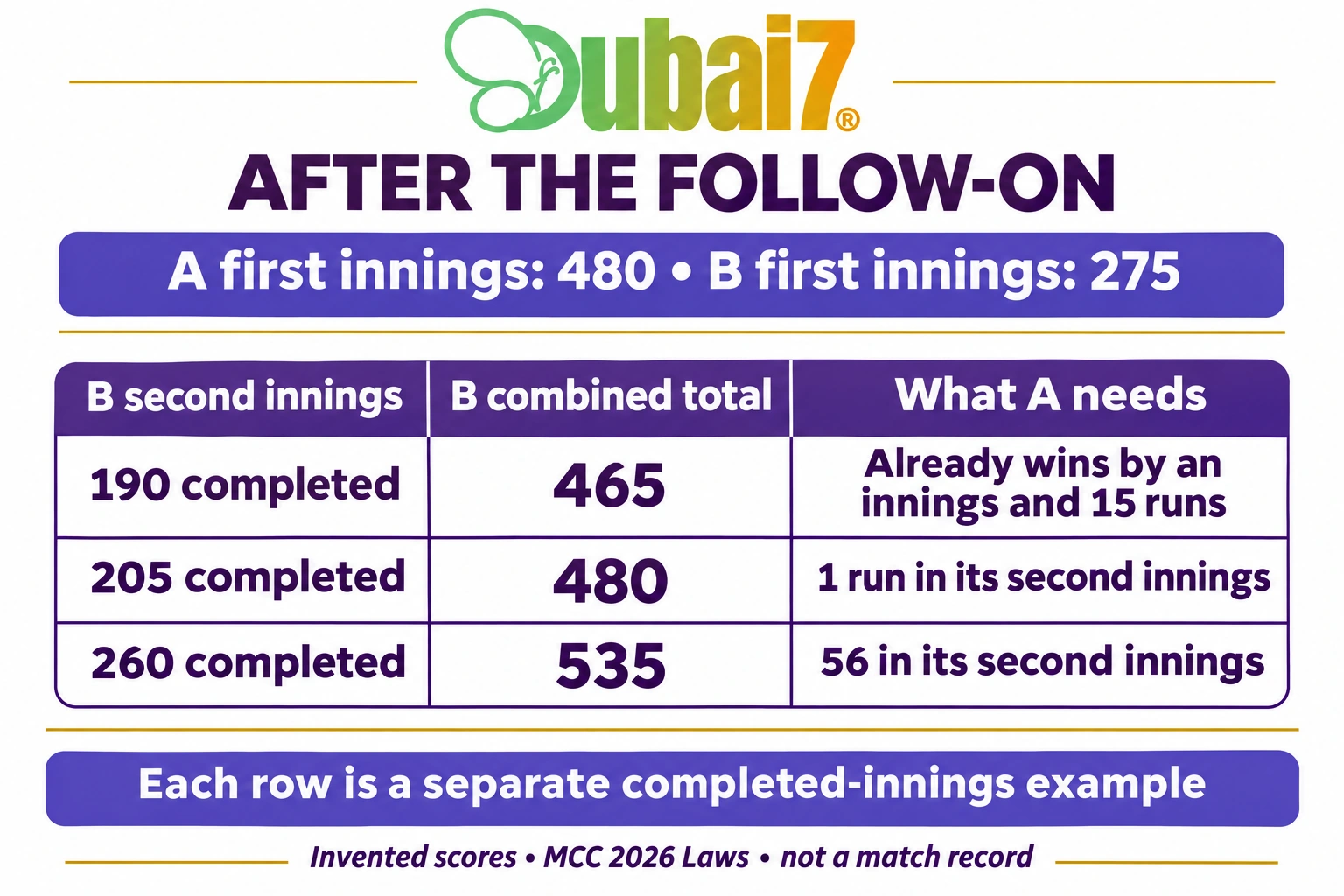
Return to the invented scores A 480 and B 275. A leads by 205 and enforces the follow-on. B’s second innings is now the next innings. What happens afterwards depends on B’s combined total, not on the fact that the follow-on was enforced.
| B's completed second innings | B's combined total | What follows from these totals? |
|---|---|---|
| 190 | 275 + 190 = 465 | A's 480 exceeds B's two completed innings: A wins by an innings and 15 runs |
| 205 | 275 + 205 = 480 | A still has its second innings available and needs 1 run to win |
| 260 | 275 + 260 = 535 | A needs 56 in its second innings to exceed B's total |
In the first row, A does not need to take a second innings. The 15-run margin is 480 − 465. It is not the earlier 205-run lead, because B added another 190 before both of its innings were completed.
In the middle row, equal aggregate totals do not automatically make the match a Tie. A has not yet used its second innings. Under the ordinary winning condition it needs to exceed 480, so one further run is enough. A Tie under Law 16.5.1 requires all innings to be completed with equal scores; it is not established by this intermediate equality.
In the last row, scoring 55 would only draw A level with B’s 535. The winning target is 56 because A starts that innings with its first 480 already counted. Think in combined totals before assigning a chase target.
The word “completed” in the table is essential. If B is still batting at 190 in its second innings, an innings victory has not yet been established merely because its current combined total is below 480. The match must satisfy the actual completion and result conditions.
Common questions
Can a team require the follow-on with a 199-run lead in a five-day match?
Not when the 200-run minimum applies. Exactly 200 qualifies; 199 does not. If the lost-first-day rule applies, establish the resulting duration category separately instead of assuming the threshold remains 200.
Does rain on any day reduce the required lead?
No. Law 14.3 is the specific no-play-on-the-first-day exception. A later interruption does not by itself let the captain replace the original category with the number of days currently left.
Is B being asked to repeat its first innings?
No. Its first innings remains part of the match record. B takes its second innings next, and the two completed totals are added when assessing the two-innings result.
Does enforcing the follow-on mean the team has already won?
No. It changes the order of innings. B can score enough in its second innings to leave A a chase, and the match still has to reach a result under the applicable conditions.
These examples use MCC’s 2026 Laws of Cricket: Laws 13.1–13.3, 14.1–14.3, 16.1, 16.5–16.6 and 17.2. The weather sequences, totals and illustration are Dubai7’s own teaching examples, not current match conditions or a bookmaker’s settlement rule.