
Cricket extras increase the team’s score without being credited to a batter. But they do not all go into the bowler’s runs conceded. Wides and the no-ball penalty are charged to the bowler; byes and leg byes are not. That is how one completed over can add 23 to the team total while adding only 16 to the bowler’s figures.
The difference is a matter of accounting, not seven missing runs. Below, we follow nine deliveries through a complete six-valid-ball over and reconcile the team, batting, extras and bowling records. It is an invented scoring exercise using MCC’s 2017 Code, fourth edition (2026), not a report of a match or a betting settlement. A competition’s own playing conditions still need to be checked for that competition.
Keep three totals separate before reading the extras
The team total collects the runs awarded to the batting side. The batting column credits particular batters. The bowling column records the runs debited to a particular bowler. They answer different questions.
For the situations in this article, use these two checks:
Team runs = batters’ runs + wides + no-ball extras + byes + leg byes.
Bowler’s runs conceded = batters’ runs + wides + no-ball extras.
Here, “batters’ runs” means the runs credited to all batters involved, rather than only the person facing at the start of the over. Other penalty awards, short runs, dismissals and overthrows are excluded from the worked over; it is not intended to cover every possible scoring incident.
| Entry | Added to the team? | Charged to the bowler? |
|---|---|---|
| Runs credited to a batter | Yes | Yes |
| Wides | Yes, as extras | Yes |
| One-run no-ball penalty | Yes, as a no-ball extra | Yes |
| Byes | Yes, as extras | No |
| Leg byes | Yes, as extras | No |
This is the division made by MCC Law 18.10 on crediting runs, printed pages 56–57 of the 2026 Laws. It is why subtracting the batters’ scores from the team total finds extras, while subtracting bowling runs from the team total does something different.
A wide with two completed runs is three wides
Suppose a delivery is called Wide, nobody touches it with the bat or body, and the batters complete two runs before it becomes dead. The team receives three: the one-run wide penalty plus the two completed runs. All three are recorded as wides and charged to the bowler.
Do not split that incident into one wide and two byes. The additional running does not change its category. If an untouched wide instead goes to the boundary for a four-run allowance, the corresponding result is five wides, assuming no other incident affects the award.
In our over below, the three-wide delivery changes the score by three but adds nothing to either batter’s personal score. It also does not use one of the over’s six valid balls.
A no-ball can have two different scoring categories
A no-ball carries its own one-run penalty. What happens to the rest depends on how those runs arise. Compare three independent examples, with no wicket or other penalty involved:
| No-ball event | Team increase | How it is recorded |
|---|---|---|
| Struck with the bat for a four boundary | 5 | Batter 4; no-ball extra 1; bowler charged 5 |
| Misses bat and body, then reaches the boundary for four | 5 | Byes 4; no-ball extra 1; bowler charged 1 |
| Hits the pad, with two leg byes properly awarded | 3 | Leg byes 2; no-ball extra 1; bowler charged 1 |
The two five-run outcomes have the same effect on the team total and very different effects on the bowling figures. Recording all five as no-ball extras in the second row would put four runs in the wrong extras category and wrongly charge them to the bowler.
The leg-bye example needs its condition. An umpire must be satisfied that the striker attempted to play the ball with the bat or tried to avoid being hit. In the table, the ball then has no further contact with the bat. Simply being struck on the pad does not automatically turn subsequent running into leg byes. If neither qualifying action occurred, the running is disallowed; a valid no-ball penalty can still remain.
These distinctions follow MCC Laws 21.12–21.16 and 23.1–23.3, printed pages 74–78. The call of No ball also overrides Wide: the same delivery does not earn both one-run penalties.
Follow the whole over, rather than guessing from its total
Two batters, A and B, begin this example with A facing. No wickets fall. Every boundary listed is a four-run allowance without an overthrow. Both bye deliveries miss bat and body; the leg bye is properly awarded after an attempted stroke, with no later bat contact. All other deliveries are valid balls.
We number the physical deliveries in the left column. They are not commentary ball labels or a count of balls faced by one batter.
| Delivery | What happens | Team runs added |
|---|---|---|
| 1 | A hits two; both runs completed | 2 |
| 2 | Wide; two further runs completed | 3 |
| 3 | No-ball; A hits a four boundary | 5 |
| 4 | Valid ball; two byes completed | 2 |
| 5 | Valid ball; one leg bye completed | 1 |
| 6 | No-ball; untouched ball reaches the boundary for four byes | 5 |
| 7 | B hits a single | 1 |
| 8 | Valid dot ball to A | 0 |
| 9 | A hits a four boundary | 4 |
The team gains 23 runs. Deliveries 2, 3 and 6 do not count towards the six-ball over. The other six do, so nine physical deliveries complete one over in this example. Byes and leg byes on otherwise valid deliveries do not themselves require a replacement ball.
The single leg bye on delivery 5 changes the striker, which is why B receives delivery 6 and hits the single on delivery 7. That single brings A back to face deliveries 8 and 9. We have not assigned every batting run to A merely because A started the over.
Reconcile all four records
A’s batting runs are 2 + 4 + 4 = 10. B scores 1. Their combined batting contribution is 11, leaving 12 of the team’s 23 as extras.
Those extras have identifiable origins:
| Extras category | Deliveries supplying it | Runs |
|---|---|---|
| Wides | Delivery 2: penalty 1 plus completed runs 2 | 3 |
| No-ball extras | Deliveries 3 and 6: penalty 1 each | 2 |
| Byes | Delivery 4 gives 2; delivery 6 gives 4 | 6 |
| Leg byes | Delivery 5 | 1 |
| Total extras | 3 + 2 + 6 + 1 | 12 |
The bowler is charged 11 batting runs + 3 wides + 2 no-ball extras = 16. The six byes and one leg bye explain the remaining seven team runs. Because there were six valid balls and no wickets, this over contributes 1–0–16–0 to the bowler’s overs–maidens–runs–wickets record.
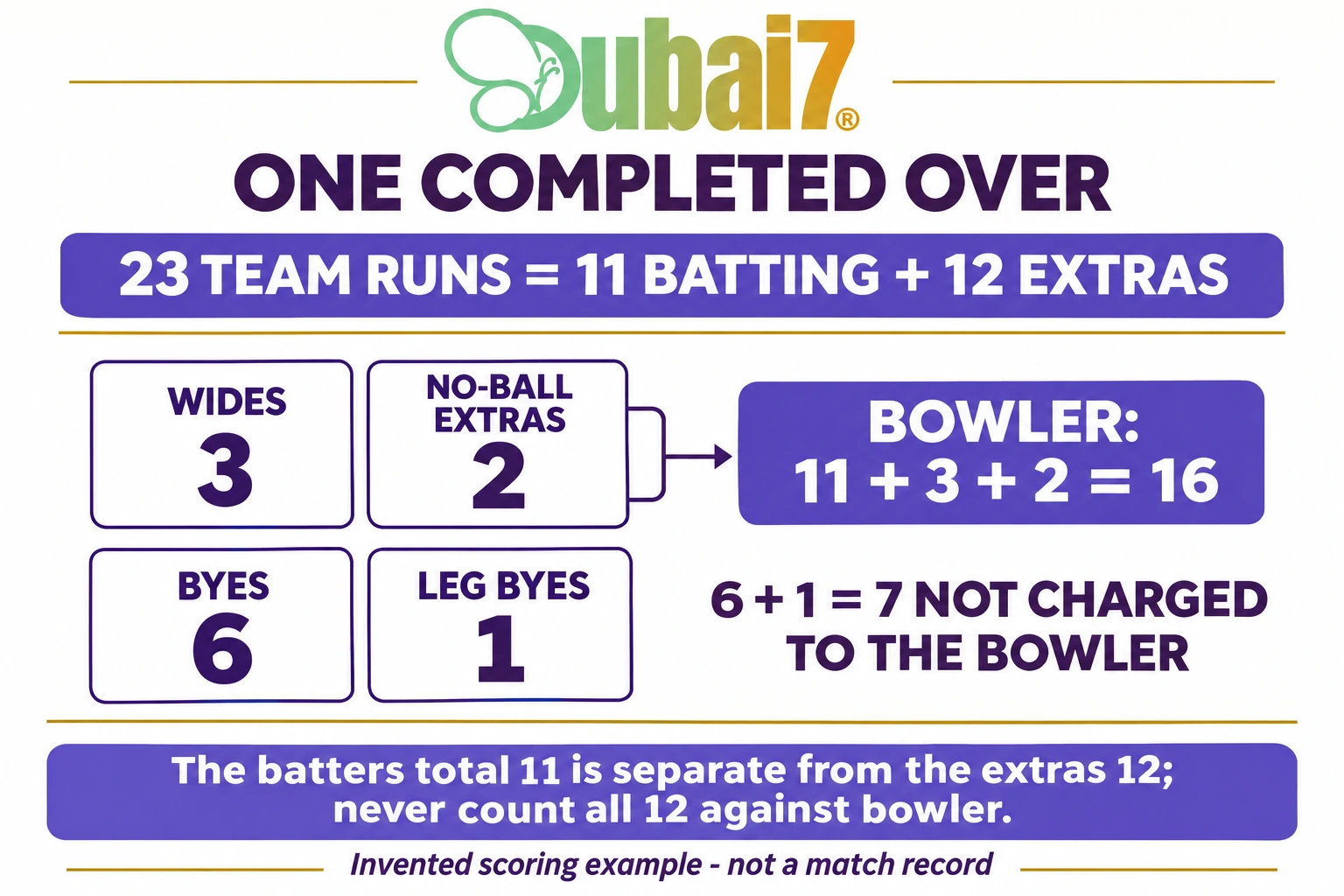
Check it in both directions: 11 batting runs + 12 extras = 23 team runs; 16 bowling runs + 7 byes and leg byes = the same 23. There is no need to force 23 into the bowler’s runs column to make the account balance.
What to check when a scorecard does not reconcile
Start with the official scoring record and the umpire’s final signals. A shorthand commentary entry such as “5nb” can be ambiguous without that service’s notation: it may describe a delivery total rather than a detailed allocation. Reconstruct the event before deciding which category is wrong.
For each disputed delivery, record whether there was a no-ball or wide call, whether the bat made contact, and how many runs or boundary allowance were awarded. Then compare the batter’s increase, the named extras entries and the bowler’s increase. A five-run delivery on a no-ball is not enough information on its own to decide whether the bowler conceded one or five.
Finally, compare records at the same update point. A live team total may update before the batting or bowling details. A temporary difference is not proof of a scoring error; a completed official scorecard provides a better basis for the reconciliation.
Common questions
Does every extra mean the bowler conceded another run?
No. In these examples, wides and the no-ball penalty do; byes and leg byes do not. Adding all 12 extras to the 11 batting runs would wrongly make the bowler’s figure 23 instead of 16.
Can a delivery be both a no-ball and a bye?
Yes: the one-run no-ball penalty and separately awarded byes can arise from the same delivery. Our delivery 6 adds five team runs as one no-ball extra and four byes, rather than five no-ball extras.
Does “three wides” mean three separate deliveries?
Not necessarily. In our delivery 2, one wide plus two completed runs produces three wides from a single physical delivery. That delivery contributes no valid ball to the over.
Are byes and leg byes the same as dot balls for the team?
No. They can increase the team’s score while adding zero to the bowler’s runs conceded. Delivery 4 adds two team runs, whereas delivery 8 adds none. Their equal bowling charge does not make their team-scoring effects identical.
Does this also explain a bet’s settlement?
It explains the cricket scoring record. A betting market may have its own definition of a bowler’s runs, team runs or an over; its published market terms need a separate check. The worked over does not establish any operator’s settlement policy.