
A striker can be stumped from a Wide, but not from a No ball. That does not mean every failed no-ball stumping becomes a Run out instead. Under the MCC Laws used here, a striker who is out of their ground, has not attempted a run, and has their wicket broken by the keeper without another fielder’s intervention is also protected from Run out on that No ball.
Change one of those facts and the decision can change. Trying to run, involving another fielder, or ending a chase with the Wide penalty requires a different check. The label “keeper took the bails off” is not enough to identify the dismissal.
This Dubai7 guide uses MCC’s 2017 Code, fourth edition (2026), especially Laws 38 and 39. The examples are invented ordinary striker-end incidents without a runner. They explain the general Laws, not a particular tournament’s playing conditions, free-hit rule or betting market’s settlement.
Start with what makes a stumping
For the basic stumping in Law 39.1, the delivered ball must not be a No ball. The striker must be out of their ground, must not have attempted a run, and the keeper must fairly break the striker’s wicket without another fielder intervening. The injury protection discussed below still applies.
That combination separates a missed stroke outside the crease from an attempted run. Imagine the striker steps forward to play, misses, and stays outside their ground. The keeper receives the ball and fairly removes a bail while the striker remains out. With an otherwise valid delivery and no exception, that is a stumping.
The striker’s move towards the ball is not automatically an attempt to run. Conversely, a Run out does not require the batters to finish a run. The question is what they attempted before the wicket was broken, not whether the score increased.
| Delivery and action | Keeper alone, striker out of ground | Basic decision in the stated conditions |
|---|---|---|
| Valid delivery; no run attempted | Wicket fairly broken | Stumped |
| Wide; no run attempted | Wicket fairly broken | Stumped can apply; check the winning-Wide exception |
| No ball; no run attempted | Wicket fairly broken | Not Stumped and not Run out under the keeper-alone exception |
| No ball; striker attempts a run | Wicket fairly broken | Run out can apply; not Stumped |
Every row assumes the ball is still in play, the correct wicket is fairly broken, and there is no injury or grounded-batter protection. These are conditions to establish, not conclusions from a cropped photograph of missing bails.
Why a wide can produce a wicket and still add a run
A Wide does not itself make the ball dead. Law 22.9 allows Stumped among the possible dismissals from a Wide. It therefore leaves the stumping conditions available, including the requirement that the striker has not attempted a run.
Use a simple example well short of the target. The score is 70/2, the delivery is called Wide, no running occurs, and the striker remains out of their ground after missing it. The keeper alone fairly breaks the wicket. If the other stumping conditions are satisfied, the score becomes 71/3: one Wide run remains and one wicket is recorded.
The wicket does not erase the Wide penalty. It also does not turn that delivery into one of the over’s six valid balls. Runs, wickets and valid-ball count are separate parts of the record.
Now change the action: after the Wide, the striker attempts a run and is put out short of the relevant ground. That is a Run out question under Law 38, rather than a stumping simply because the keeper handles the ball. The final dismissal type depends on the completed incident and the applicable exceptions.
Why the same keeper action is not a run-out shortcut on a no-ball
Law 38.1 normally allows Run out even when No ball is called and whether or not a run is attempted. But it expressly points to an exception. Law 38.2.2.2 protects the striker when all three facts coincide: No ball, no attempted run, and the wicket fairly broken by the keeper without another fielder intervening.
Suppose the striker advances to play a No ball, misses, and makes no attempt to run. The keeper takes it and fairly breaks the wicket while the striker is still outside. A stumping is unavailable because the delivery is a No ball. In these exact circumstances the Run out exception also applies, so relabelling the keeper’s action does not create a dismissal.
The No ball penalty still exists. With no other scoring incident, the team adds one run, keeps the same wickets lost, and the delivery does not count as a valid ball. That result does not authorise the striker to run freely afterwards: the call of No ball does not itself make the ball dead.
| Change to the same No ball incident | What happens to the exception? | What to check next |
|---|---|---|
| Striker makes no attempt to run; keeper acts alone | All keeper-alone protection conditions remain | Neither Stumped nor Run out from this action |
| Striker attempts a run before being put out | The no-attempt condition is absent | Run out under Law 38 can apply |
| Another fielder intervenes before the wicket is broken | The keeper-alone condition is absent | Run out can apply if its conditions are met |
| Striker is safely within their ground at the relevant instant | The out-of-ground requirement is absent | Neither dismissal follows merely from broken bails |
“Can apply” matters in the middle rows. Another fielder touching the ball does not automatically make someone out. There must still be a live ball, a batter out of the relevant ground, a fairly broken wicket and no applicable protection.
A rebound from the keeper is different from another fielder’s intervention
A keeper need not always catch the ball neatly before completing a stumping. Law 39.2 treats a ball that rebounds from the keeper’s person or equipment onto the stumps as the keeper breaking the wicket. It also covers the keeper kicking or throwing the ball onto the stumps.
For example, on a valid delivery the striker misses outside their ground without attempting a run. The ball strikes the keeper’s pad and rebounds onto the stumps, removing a bail. That rebound can satisfy the keeper-action part of Stumped; it is not automatically another fielder’s intervention.
Compare a ball deflected by a slip fielder before the keeper breaks the wicket. Now another fielder has intervened, so the keeper-alone requirement for Stumped is not met. The same involvement also prevents use of the specific keeper-alone No ball protection. A Run out may be the relevant decision if Law 38’s other requirements are present.
These examples distinguish the fielders’ roles. They do not mean that any loose ball striking any stump dismisses a batter. Fairly breaking the wicket and the batter’s ground must still be established.
Check the ground and the wicket at the decisive moment
Under Law 30.1, some part of the batter’s person or bat must be grounded behind the popping crease to establish that ground. Being close to the line, or holding a bat above it, is not the same as having it grounded behind it.
There is also protection for a batter running or diving towards their ground and beyond. If they have already grounded part of their person or bat beyond the popping crease, a subsequent loss of ground contact does not by itself make them out of their ground under Law 30.1.2. Do not freeze the video at the later airborne frame and discard what happened just before it.
The wicket must be fairly broken as well. Law 29 requires complete removal of at least one bail, or removal of a stump from the ground, by one of the permitted means. Merely shaking a bail is not complete removal. Where a hand or arm is used to remove it, the ball-holding requirement in Law 29.2 must be satisfied.
The keeper’s position can affect the delivery too. Law 27.3 requires the keeper to remain wholly behind the striker’s wicket until the ball touches the striker’s bat or person, passes that wicket, or the striker attempts a run. A breach brings a No ball call, which changes the Stumped check. “Quick hands” do not remove the positioning rule.
A wide that wins the chase ends the opportunity for a stumping
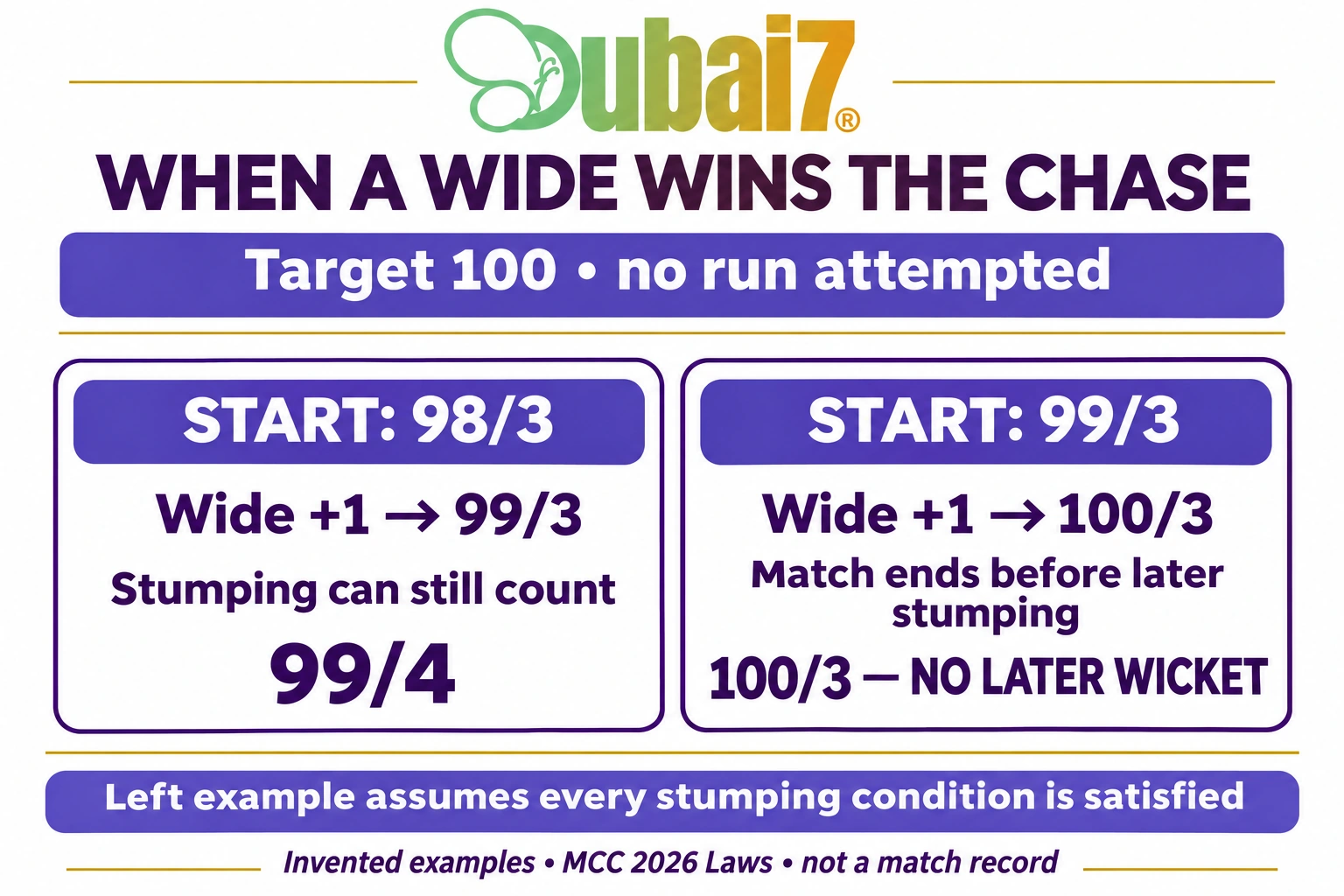
The 2026 text of Law 39.4 explicitly addresses this timing. If the Wide penalty itself concludes the match, a stumping is not possible. The one-run Wide penalty remains.
Compare two separate one-innings chases with a target of 100. No run is attempted, no other award occurs, and the keeper would otherwise satisfy all the stumping conditions after the Wide.
| Score before the Wide | Effect of its one-run penalty | Can that later stumping count? |
|---|---|---|
| 98/3, target 100 | Becomes 99/3; chase is not yet won | Yes, if all conditions hold: 99/4 |
| 99/3, target 100 | Becomes 100/3 and wins the match | No; the later keeper action adds no wicket |
The difference is not a special exemption for the last over. It is that reaching the winning total ends the match under Law 16.6. Check the required target and the score before the delivery, rather than assuming every Wide plus removed bail gives one run and one wicket.
Injury protection is a separate question
Law 39.3.1 protects the striker from Stumped when, after receiving the delivery, they leave their ground to avoid injury. Law 38.2.1.1 also protects a batter who had been within their ground and subsequently leaves it to avoid injury when the wicket is broken.
That is different from simply losing balance after playing a stroke. A spectator cannot establish the injury condition merely by seeing the batter outside. The reason for leaving, the sequence and the umpire’s decision matter. Likewise, the protection for a completed dive into the ground should not be confused with a batter who never reached the ground at all.
For a disputed record, keep the full sequence: final delivery call, run attempt, ground contact before and at the wicket break, the keeper’s action, any other fielder’s intervention, and the chase score. Those facts determine which branch to examine. A single final scorecard label cannot reconstruct them all.
Common questions
Does the keeper’s name on a scorecard prove it was Stumped?
No. The keeper can participate in a Run out as well. The dismissal’s conditions and the official recorded method matter; the identity of the player who removed the bails does not decide the category on its own.
Can a No ball and a Wide both be used in the same decision?
No ball overrides Wide under Law 21.12. Establish the final call before choosing a dismissal branch. Do not retain the Wide-based stumping route after the delivery has been called No ball.
Must a whole run be completed before a Run out is possible?
No. Law 38.1 allows Run out whether or not a run is being attempted, subject to its exceptions. Completing a run is not the threshold. The keeper-alone No ball exception is one of the important limits on that general rule.
Is the non-striker’s early-departure dismissal a stumping too?
No. Stumped in Law 39 concerns the striker and the keeper at the striker’s wicket. The non-striker leaving early is dealt with separately by Law 38.3; it is not a reason to transfer the stumping checklist to the other end.
The conditions and examples above use MCC’s 2026 Laws of Cricket: Laws 38.1–38.2 and 39.1–39.4, with Laws 16.6, 17.3, 21.12–21.17, 22.5–22.9, 27.3, 29 and 30 for the specific checks described. All scores and sequences are Dubai7 teaching examples, not match footage or a claim about a bookmaker’s terms.