
In the published Football Studio Top Card rules used here, a Draw returns half of an accepted Home or Away main bet. It is a half-loss on that selection, not a full push. A separate accepted Draw bet instead wins at 11:1 profit odds, with its winning stake retained. Those are different treatments of the same pair of equal-value cards.
That explains an account which shows a positive return but still ends below its starting balance. Returning 50 from an accepted Home bet of 100 leaves a net loss of 50. It does not mean Home won 50, and it does not entitle an account with no Draw bet to the Draw payout.
This Dubai7 guide follows the live Football Studio (Top Card) chapter in Evolution’s v2.7.4 rulebook, checked against win2day’s published Football Studio terms. This is the card game: it is separate from Football Studio Dice, roulette and betting on a football match. The examples below explain rules and balances; they do not confirm game availability through this information site.
Start with the cards, not the football labels
The cited game deals one face-up card to Home and one to Away from an eight-deck shoe with no Jokers. The higher card wins. Card order runs from 2 at the bottom through 3–10, J, Q and K to Ace at the top.
There is no multi-card hand total to make. A 10 is lower than a Jack; an Ace is higher than a King. Two cards of the same rank produce a Draw. The published result is determined by card value, so a difference in suits does not make one Queen higher than another Queen.
| Home card and Away card | Result under the cited rank order | What the labels do not mean |
|---|---|---|
| Home Ace, Away King | Home | Ace is not the low card here |
| Home 10, Away Jack | Away | Face cards are not all assigned a tied value of ten |
| Home Queen, Away Queen | Draw | Different suits do not break the equal-value result |
| Home 2, Away 3 | Away | Home has no automatic advantage from its label |
These are teaching card pairs. Home and Away identify the two dealt hands; a team’s sporting form, an actual match score or the club name beside a broadcast does not determine which dealt card ranks higher.
That is why importing another game’s Ace-low order would change the result. Read the named game’s rank order before interpreting the settlement. The words Home, Away and Draw may look familiar while referring to a different underlying event.
Three bet types, three separate settlement entries
A winning Home or Away bet pays 1:1 profit odds. For a 100 accepted main stake, that means 100 profit plus the winning stake, giving a gross return of 200. A main bet on the lower card returns zero. If the two card values are equal, half of that main stake is returned.
A Draw bet is its own accepted selection. Under the cited 11:1 schedule, a winning Draw stake of 10 produces 110 profit plus its winning stake of 10, giving a return of 120. If the card values differ, that Draw selection loses.
| Accepted selection | Result that wins it | Treatment when the card values are equal |
|---|---|---|
| Home | Home card ranks higher | Half of its main stake returned; half lost |
| Away | Away card ranks higher | Half of its main stake returned; half lost |
| Draw | Equal card values | 11:1 profit plus its own winning stake |
The same Draw result can therefore produce different credits in different accounts. One person may have only a Home selection, another only Draw, and a third a record containing both. Compare the accepted selections before comparing their closing amounts.
The published rule describes half-return for a main bet. It does not halve the 11:1 Draw profit just because the result is a Draw. Conversely, the Draw paytable does not turn a Home selection into an unrecorded winning Draw bet.
One main bet: a return of 50 is a net loss of 50
Use an invented balance of 1,000 and a single accepted Home stake of 100. There are no Draw stakes, fees, refunds or other transactions in this account. Acceptance takes the balance to 900.
| Dealt result for this account | Closing return | Ending balance and net change |
|---|---|---|
| Home higher | 200 | 1,100; net +100 |
| Away higher | 0 | 900; net −100 |
| Equal card values | 50 | 950; net −50 |
The equal-values row is a partial return of the original 100, not 50 profit. Adding the 50 to the balance that existed before acceptance would produce 1,050, which ignores the stake already deducted. Returning the entire 100 would produce 1,000, which treats the result as a push despite the half-return rule.
For an Away-only account of the same size, the two decisive-result rows swap. The Draw row still returns 50 from the 100 main stake. The half-return rule does not depend on which of the two main labels the player selected.
If the record contains Home and Draw, include both costs
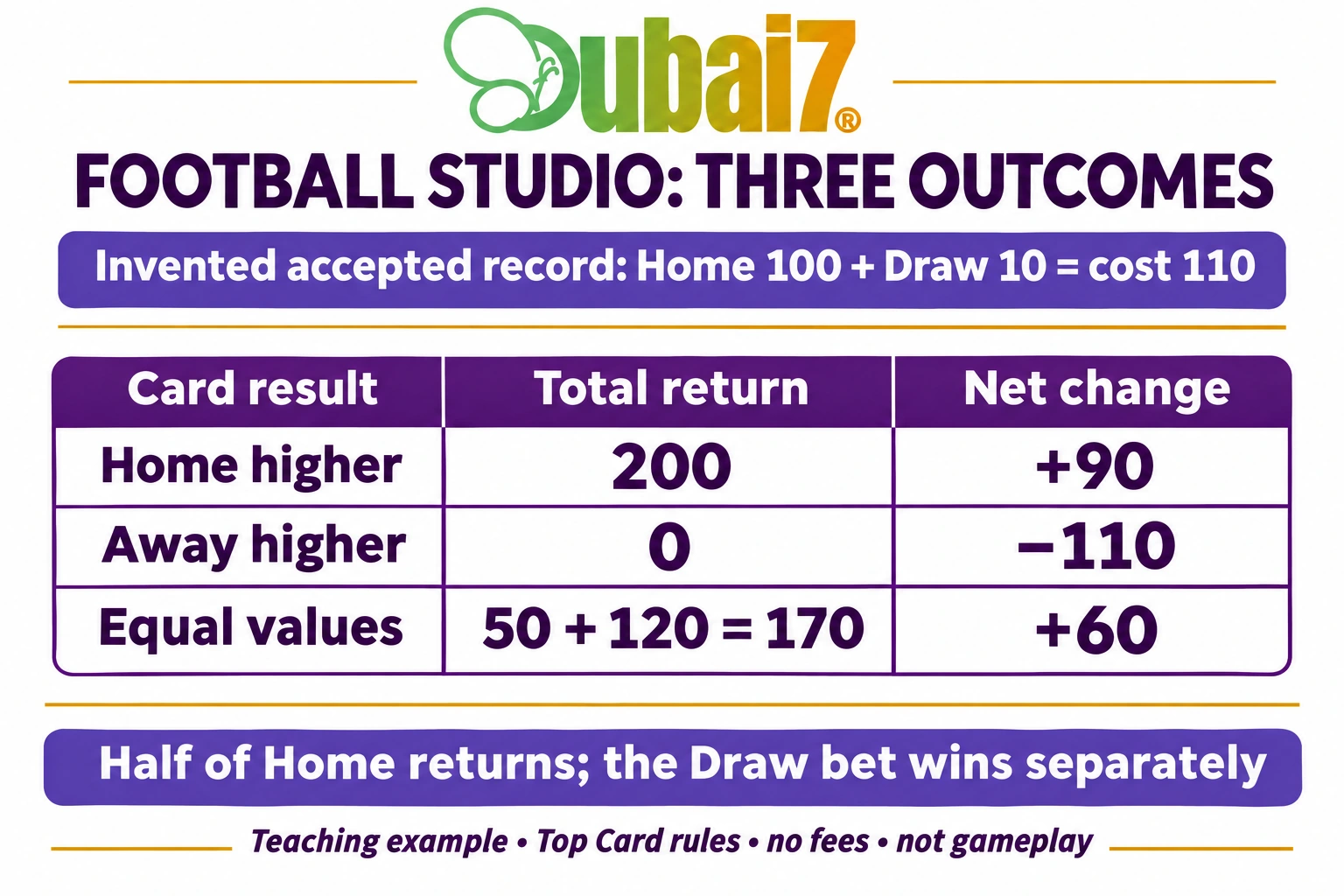
Now use a separate invented account whose accepted wager record contains 100 on Home and 10 on Draw. These numbers describe an account to reconcile; they are not a recommendation to combine bets or a claim that every interface accepts that combination. The full recorded cost is 110, leaving 890 from a starting 1,000.
| Result | Total return from the recorded selections | Net after the full 110 cost |
|---|---|---|
| Home higher | Home 200 + Draw 0 = 200 | +90 |
| Away higher | Home 0 + Draw 0 = 0 | −110 |
| Equal card values | Home half-return 50 + Draw return 120 = 170 | +60 |
In the equal-values branch, the ending balance is 890 + 170 = 1,060. The Draw bet’s 110 profit does not equal the whole account’s net gain: the Home selection has lost 50, leaving a combined +60.
In the Home-win branch, the Home bet makes 100 profit but the separate Draw stake of 10 loses. The whole account gains 90. Looking only at the winning bet would hide the losing selection in both branches.
These are three alternative outcomes of the same accepted selections. They are not three consecutive rounds, and the two positive branches do not establish a guaranteed profit. The Away result still loses the full 110 in this constructed account.
Why 11:1 does not mean a Draw occurs once in twelve rounds
Payout odds describe the amount paid for a win; they are not a statement that every twelfth result is a Draw. The named rules use an eight-deck shoe and define thirteen card ranks. A probability calculation needs a model of the cards available, rather than reading a frequency directly from the paytable.
For a clearly limited model, suppose the two dealt cards are sampled uniformly without replacement from a full eight-deck shoe. There are 416 cards. Once the first card is known, 415 remain, including 31 of its rank: eight decks times four suits gives 32 cards of that rank before the first is removed.
The Draw probability in that full-shoe model is therefore 31/415, approximately 7.47%. It is not 1/12, approximately 8.33%. That model describes a fresh full shoe; it is not a prediction for a particular remaining shoe, a run of previous results or an operator’s actual dealing system.
As an arithmetic cross-check, paying a gross 12 for a winning one-unit Draw stake gives an expected gross return of 12 × 31/415 = 372/415, approximately 89.64%. That agrees with the Draw RTP rounded in the cited rulebook. It does not turn 89.64% into a promise that a short session will return that amount.
For the main bet in the same symmetric full-shoe model, the half-loss when a Draw occurs accounts for a loss rate of half of 31/415, approximately 3.73%. The corresponding expected gross return is approximately 96.27%, matching the rulebook’s rounded main-bet figure. This cross-check also shows why a full-push assumption would describe a different schedule.
Read a return label alongside the actual debit
A result display can show a returned amount without showing the cost beside it. When checking a Draw, identify the accepted bet type, accepted stake, card ranks, returned amount and the original stake debit. Then calculate ending balance or net change across the whole account.
For the main-only example, the useful chain is 1,000 − 100 + 50 = 950. For the account containing both Home and Draw, it is 1,000 − 110 + 170 = 1,060. Those are complete accounts; neither uses a displayed return as if it were pure profit.
If a record says only “Draw” and “50,” it still lacks the accepted stake and selection. Fifty returned from a 100 main bet is consistent with the cited half-return rule. It would not, by itself, explain the settlement of an accepted 10 Draw bet under the named 11:1 schedule.
Common questions
Is a Draw a push for Home or Away?
Not under this schedule. Half of the main stake is returned and half is lost. A 100 main stake returns 50 on equal card values, producing a net loss of 50 on that selection.
Does a winning 10 Draw bet return 110 or 120?
The cited 11:1 schedule means 110 profit, with the winning 10 stake retained, so gross return is 120. Keep that separate from any partial return or loss on another accepted selection.
Can a different suit break a tie between two Kings?
The named result compares card value. Equal ranks produce a Draw; it does not assign a suit order that makes one King win over another King. Also remember that Ace ranks above King in this game.
Can previous Draw results tell me the next result is due?
The full-shoe calculation above is not a prediction from a recent result pattern. It does not provide the remaining shoe, card-removal history or dealing procedure needed to model a particular next deal. A payout or RTP figure cannot supply those missing facts.
Sources: published Evolution Football Studio (Top Card) rules, physical page 25 and win2day’s Football Studio terms and payout table. The full-shoe probability model, balances and diagram are Dubai7 teaching calculations, not a real game record or an operator-specific availability claim.